

Acoustic Pods and Employee Wellbeing: More Than Just Silence
A quieter office can be a more comfortable place to work. But silence alone does not make a good workspace. People also need privacy for conversations, a suitable place for the task at hand and enough control over their surroundings.
That is where acoustic Eco Pods can play a role. They add dedicated spaces for calls, focused work and meetings within a larger office. Their value lies in giving people a choice of where to work, rather than expecting every activity to happen at the same desk.
Why is office noise about more than volume?
A conversation across the room may be more distracting than a steady background sound, even when it is not especially loud. Speech draws attention, particularly when someone is trying to read, write or think through a difficult task.
Privacy matters too. An employee who needs to discuss a sensitive subject should not have to search for an empty meeting room or worry about being overheard. Research into open offices links acoustic comfort with factors such as workplace satisfaction and people’s ability to choose a suitable space for their work. It does not show that one product, by itself, improves employee wellbeing.
Acoustic design therefore needs to consider two people at once: the person having a conversation and the colleagues working nearby.
How do acoustic Eco Pods support privacy and choice?
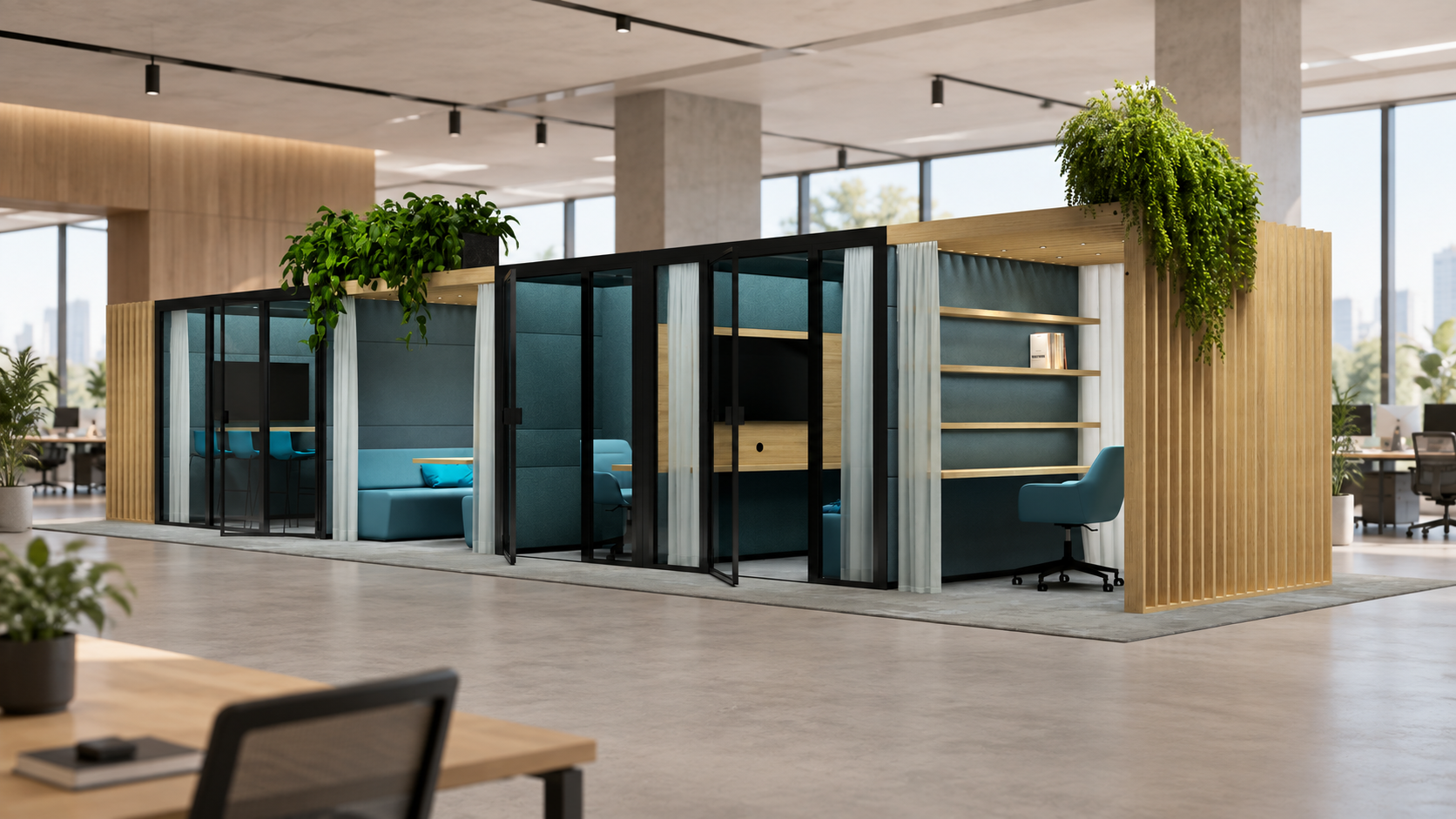
An acoustic Eco Pod gives a task a defined place. Someone can step into a Focus Eco Pod for a call or individual work. Colleagues can use a Collaboration Eco Pod for a discussion without holding it beside occupied desks.
That choice helps people match their surroundings to what they are doing. It can also make the purpose of each area clearer: a shared desk area can remain available for everyday work, while calls and meetings have spaces of their own.
The acoustic performance must be described precisely. Ecolution Design reports ISO 23351-1 Category A performance and a 30.6 dB speech level reduction for its tested Eco Pods. That is a measure of speech reduction, not a promise of complete silence or guaranteed confidentiality in every office setting.
Why does comfort inside an Eco Pod matter?
A space may reduce sound effectively, but people still need to feel comfortable using it. The intended activity should guide the choice of Eco Pod. A brief phone call has different demands from an extended period of desk work or a team meeting.
Lighting, airflow, seating and access to power all affect how usable the space feels. Ecolution Design covers these elements alongside acoustics in its technical specifications. Its newer lighting system is designed to provide even light for focused work, video calls and collaboration.
The practical question is simple: will people choose to use this space for the work it is meant to support? If the answer is no, acoustic performance on its own will not solve the problem.
Can one quiet space meet everyone’s needs?
People respond differently to busy surroundings. Their needs also change throughout the day. An employee might welcome the energy of a shared workspace in the morning, need a private call space after lunch and join a team discussion later.
This is why workplace wellbeing calls for a mix of spaces, with clear purposes and easy access. A single quiet room may be occupied when it is needed most. Several spaces for different activities can give employees more useful options.
Research on acoustic comfort in open offices recommends a greater variety of functional workspaces so employees can choose an area that suits their task. That is a sound principle for planning an office, although the right mix will differ between organisations.
Where should acoustic Eco Pods go in the office?
Placement affects whether an Eco Pod becomes part of the working day. A call space should be easy to reach when a conversation starts. A space for sustained focus should not sit on a busy route where people constantly pass its door. Meeting spaces need to be convenient for groups without sending everyone through a quiet work area.
Before choosing a layout, observe how the office is used. Where do calls take place now? Which meeting rooms are most often full? Where do people go when they need to concentrate? These observations can guide both the number and position of Eco Pods.
As teams change, the layout may need to change with them. Ecolution Design’s modular system allows Eco Pod configurations to be adjusted or expanded, making it possible to revisit the balance between focus and collaboration over time.
A better workplace starts with more choice
Employee wellbeing is shaped by many things, and an acoustic Eco Pod cannot address them all. What it can do is give people a dedicated option when the open office does not suit the task in front of them.
The goal is more than silence. It is an office where a private call has a place, focused work has a place and collaboration has a place. Start with how your people actually work, then explore the mix of Focus Eco Pods and Collaboration Eco Pods that fits those needs.
