

Teams rarely stay the same size. A department that needed one office phone booth two years ago now needs space for video calls, project work and team meetings. The question is what to do with the Pods you already have.
Connecting office pods is one answer: place Pods side by side, or join them into one larger room. The concern is sound. A Pod keeps conversations private because it is closed on every side, and joining two Pods creates new seams. In this article, we explain where sound can escape when pods are joined, how Connected Eco Pods keep their Category A rating, and what to check before you expand.
Why teams outgrow their pods
A Pod is often chosen for the team of today. Then the way people work changes.
Teams grow. More people share the same few quiet spaces, and queues form outside the door.
Meetings go hybrid. A call with remote colleagues needs a screen, a camera position and room for several people at one table.
Project work takes longer. A team that works together for a full afternoon needs a whiteboard, power for every laptop and fresh air.
The usual answers each have a drawback. A new built meeting room takes construction time and stays fixed in place. A bigger pod often sends the old one into storage or into a skip. More separate pods spread people across the floor when they want to work together.
Connecting pods keeps what you already have and adds to it.
Where acoustic performance is lost when pods are joined
A pod's speech level reduction depends on the whole enclosure: walls, glass, roof, floor and door. The ISO 23351-1 standard measures that complete result. Sound takes the weakest path, so every gap counts.
When pods are joined, these are the points to watch:
The joint between two frames. Even a small gap lets speech through.
The floor and ceiling at the join. Plinths, ceilings and their openings continue from one pod into the next.
Ventilation. Pods need fresh air. Openings must stay open without becoming a direct route for sound.
Cable routes. A cable that passes from one pod to the next needs a route that does not leave an open hole.
Doors. More modules often mean more doors, and every door needs its own seal.
How Connected Eco Pods keep Category A performance
Ecolution Eco Pods are designed to be joined. Every Eco Pod reaches 30.2 dB speech level reduction, rated Category A under ISO 23351-1. When Pods are coupled, that speech level reduction is kept.
The construction explains why:
Glass: double laminated 10.7 mm glass with an acoustic interlayer.
Walls: 110 mm sound-absorbing panels.
Door: an automatic drop seal that closes the gap at the floor.
Plinth and ceiling: a sound labyrinth lets air in and out while it dampens speech.
Cables: power runs from one Pod to the next through a small opening in the ventilation plinth, or over the top. The ventilation holes at the bottom stay open.
There are two ways to join Eco Pods.
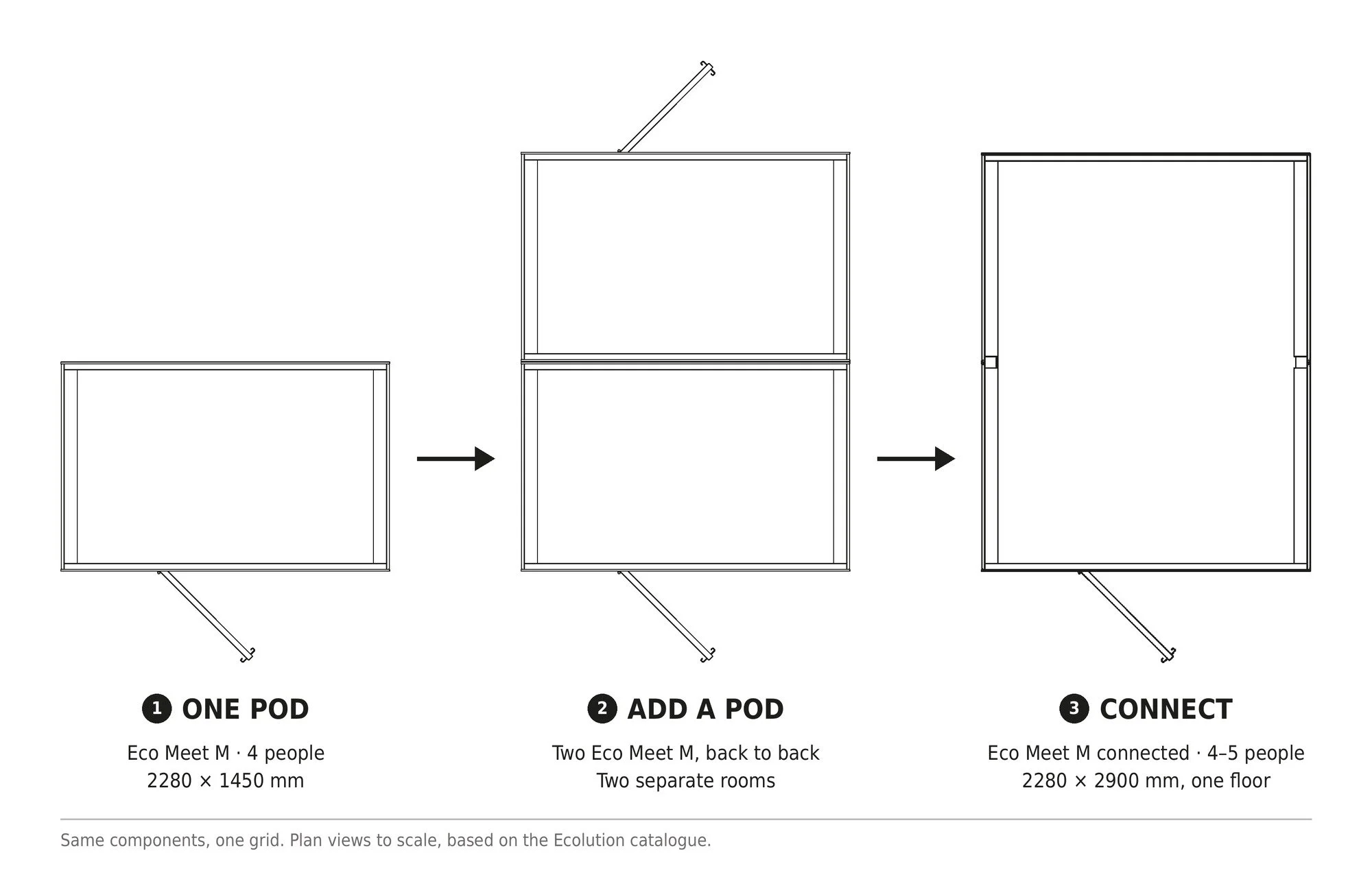
Pods in a series. Pods of different sizes stand side by side in one row, and each Pod stays its own room. For example: a phone Pod, a desk Pod and a meeting Pod in one line.
Connected Pods. Modules are joined into one continuous room for 4 to 11 people, with a threshold-free floor without a plinth in the middle, one central presence sensor and power across the modules. For team rooms, project rooms and larger hybrid meetings.
The Connected collection has nine configurations, from the Eco Multi M Connected to the Eco Max XL Connected. Installed as specified, they keep their ISO 23351-1 Category A performance. In practice, a Connected Pod works as a modular meeting room: a freestanding room-in-room that can be extended later. With space for up to 11 people, it is also an answer for teams looking for a large meeting pod.
From one Pod to a team room: growth paths
Because every Eco Pod is built from the same components on one grid, growth happens in steps. You do not have to plan the final room on day one.
Add a Pod next to the first. Pods of different sizes can stand in one row and share a power route.
Combine depths. Connected Pods can mix different depths to fit the floor you have.
Expand the room later. Add modules to a Connected Pod when the team grows. The joint cover can hold sockets and an optional screen mount.
Improve the route in. Reverse the hinge or add a second door at the back, so people can enter from the side that suits the new layout.
Change the purpose. A Meet Pod can later become a Focus Pod. The frame stays; the interior changes.
Each step reuses what is already there. Panels and parts can be exchanged, and every Eco Pod comes with an Eco Passport. Seven independently verified EPDs cover the complete collection, so the environmental data stays clear as the setup grows.
What to check before you connect pods
A few questions make the difference between a row of boxes and a space that works.
Capacity and use. How many people use the space, how often, and for what: calls, focus work or meetings?
Floor space. Measure the footprint plus the door swing and the walkway around it.
Power and screens. Mark where power arrives and where a screen should hang.
Ventilation. Keep the openings in the plinth free, also where Pods meet.
Acoustic evidence. Ask for the ISO 23351-1 result of the complete enclosure, not a material absorption figure. Our article on what ISO 23351-1 Category A means explains the difference.
The next step. Decide which module you might add later, and keep floor space free for it.
Frequently asked questions
Do office pods lose sound insulation when you connect them?
That depends on how the joints, floor, ceiling, ventilation and cables are solved. Ecolution Eco Pods keep their 30.2 dB speech level reduction (ISO 23351-1, Category A) when they are coupled.
How many people fit in a connected office pod?
Connected Eco Pods form one room for 4 to 11 people, depending on the configuration. The collection has nine Connected configurations.
Can I expand an office pod later?
Yes. Eco Pods are built on one grid, so you can place a new Pod next to an existing one or add modules to a Connected Pod. A Meet Pod can also become a Focus Pod later.
Plan your connected space
Growth should not mean starting over. With Pods that connect without losing speech level reduction, the Pod you bought for a small team can become part of the room for a larger one.
Share your floor plan, team size and intended use, and we will propose a layout with the right combination of models and depths. Request a layout proposal, or build your own line-up in the Create your own configurator. You can also explore the Connected Pods collection or read how we build for a circular economy.
[BEELD – vervangen door foto] An Eco Max XL Connected in an office setting, a team at the table, glass front facing the viewer.

