

Focus vs. Collaboration: Finding Balance in the Office
A workday rarely stays in one mode. Someone might start with a private video call, spend the next hour writing a proposal and then join colleagues to review it. Yet many offices ask all three activities to happen in the same open space.
The question is not whether an office should support focus or collaboration. It is whether people can find the right space for each task, when they need it. At Ecolution Design, we address those needs through two complementary Eco Pod collections: Focus and Collaboration.
What does focused work need?
Focused work takes several forms. A short phone call needs privacy and a place to speak without disturbing nearby desks. Writing, analysis or detailed project work may require a comfortable space for longer periods. A video meeting adds another consideration: the person on the call needs to hear and be heard clearly.
The Focus Eco Pod collection includes different configurations for these activities. Eco Phone models provide a space for calls and video meetings. Eco Work and Eco Desk models offer options for individual work, while Eco Multi models add further flexibility.
Choosing between them starts with a simple question: what will people actually do inside the space, and for how long? A place for a ten-minute call has different requirements from a place for an afternoon of concentrated work.
The downside of open office design
Open offices are designed to encourage interaction. In practice, they often introduce constant distraction. Without acoustic separation or visual privacy, employees are exposed to noise, movement and interruptions throughout the day. This makes it difficult to perform deep, focused work.
The result is a measurable impact on:
productivity
accuracy
mental workload
When employees lack control over their environment, both performance and job satisfaction decline.
Why balance requires flexibility
An effective office supports multiple ways of working within one environment.
Throughout the day, employees need to switch between collaboration, focused work, quick check-ins and private conversations. Many offices fail here. They offer either open space or enclosed rooms that are limited in availability and often inefficient to use. The key is flexibility giving employees the ability to choose how they work, without adding complexity.
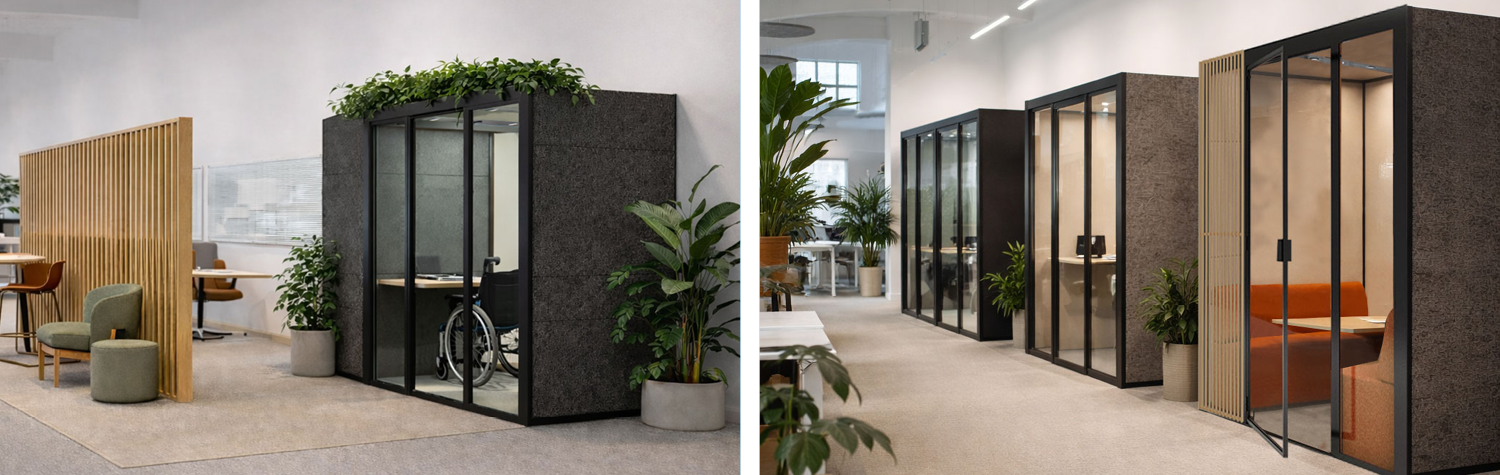
Design around the workday, not a single floor plan
Consider a typical project team. In the morning, one person joins a client call while two colleagues prepare separate proposals. Later, the group meets to compare ideas. The same people need different surroundings within a few hours.
A useful office layout makes those transitions straightforward. Open areas can support informal contact. Focus Eco Pods offer dedicated space for individual tasks and calls. Collaboration Eco Pods provide a setting for discussions that need more separation from the surrounding office.
Placement is part of the decision. People should be able to reach the right space without crossing a quiet area each time they gather for a meeting. Looking at movement, availability and booking habits can be as useful as looking at the floor plan itself.
What happens when your needs change?
The balance that suits an organisation today may shift as teams grow, roles change or hybrid meeting patterns develop. That is why adaptability belongs in the design brief from the start.
Ecolution Design builds its Eco Pods on a modular grid. Components can be changed, and configurations can be expanded or connected as workplace needs evolve. Our Modular Landscapes show how focus and meeting spaces can form part of a wider, adaptable office layout.
This approach also supports a longer view of the investment: a change in how people work does not automatically mean replacing the entire space.
Start with the activities you need to support
A balanced office gives people a suitable place to concentrate, connect and move between the two. The best starting point is a clear picture of your team’s working patterns: the calls they take, the work that needs quiet and the conversations that need a room.
From there, you can choose the mix of Focus Eco Pods and Collaboration Eco Pods that fits your workplace now, with room to adapt later.
