

Why open offices can be hard for neurodivergent colleagues
Sensory needs differ from person to person. One colleague is distracted by speech, another by flickering or harsh light, a third by the feeling of being seen. What they often have in common is that the open office offers few places to step away from it all.
That matters for focus, but also for recovery. A short break in a calm space can help someone get back to work instead of pushing through until the end of the day. The goal is not to separate people. It's to offer a choice.
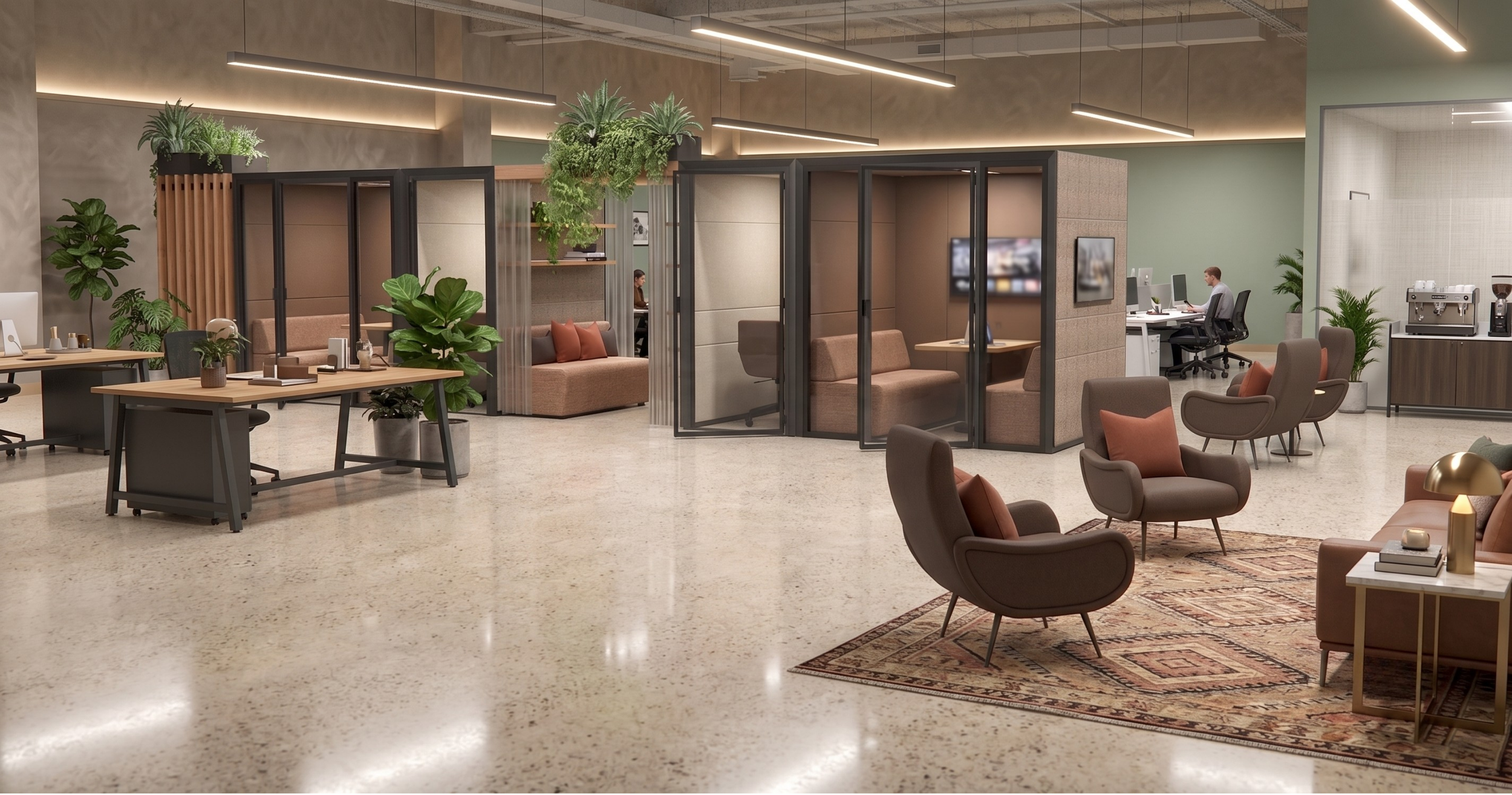
What makes a workspace sensory-friendly
A sensory-friendly workspace gives people control and predictability. In practice, that comes down to a few questions:
Can you reduce what you hear, especially speech?
Can you adjust the light, or at least rely on it being steady?
Is the air fresh without a noisy fan?
Can you use the space without asking, explaining or booking far ahead?
Can everyone get in, including people who use a wheelchair?
A well-designed office phone booth or focus pod can answer all five. Here's how we approach each one in an Ecolution Pod.
Less sound: what Category A means in practice
Speech is the hardest sound to ignore, because our brains automatically try to follow it. That's why ISO 23351-1 measures how much a pod reduces speech level, rather than general noise.
Ecolution Pods are certified ISO 23351-1 Category A, with 30.2 dB speech level reduction. That performance comes from the build-up of the Pod: double-laminated 10.7 mm glass with an acoustic interlayer, 110 mm sound-absorbing panels, an automatic drop seal in the door and a sound labyrinth in the plinths and ceiling.
For the person inside, it means conversations outside fade into the background. For the people outside, a video call inside doesn't become everyone's business. Read more in our blog What does ISO 23351-1 Category A mean?
Light without flicker
Many people never notice the flicker of standard lighting. Some people with heightened sensory sensitivity do, and it can make a space tiring to be in.
Every Ecolution Pod uses 48V lighting that is 100% flicker-free. Our Adaptive Lighting System adds control: a display inside the Pod offers three modes, Active, Ambiance and Twilight, with a range from 0 to 3,400 lumen and 2,200 to 6,500 K. Someone who needs bright, cool light to concentrate can have it. Someone who needs a softer, warmer setting to calm down can choose that instead.
Flicker-free light is not a treatment, and we don't present it as one. It can contribute to a calmer space, and that's a meaningful difference in a working day. More on light in Human-Centric Lighting for Acoustic Pods.
Fresh air without noise
A quiet space with stale air quickly becomes uncomfortable, and a loud fan undoes the quiet. In an Ecolution Pod, a motion sensor switches on the lighting and the silent ventilation as soon as someone steps in. The air inside is refreshed within two minutes.
There's nothing to set up and nothing to remember. For people who find unpredictable environments draining, a space that simply works the same way every time is part of what makes it calm.
Access for everyone
A sensory-friendly space should also be physically accessible. Every Ecolution Pod has a low threshold at the entrance. Our wheelchair-accessible Pods, the Eco Multi L and XL, also have a 917 mm-wide door, a 1,500 mm turning circle inside and a height-adjustable tabletop. A door ramp is optional.
Accessibility and sensory comfort often go together. The person who needs a quiet place today may also be the colleague who uses a wheelchair, or the visitor you haven't met yet. Read more in How wheelchair-accessible office pods improve inclusive workplaces.
Planning quiet spaces on your floor
A pod only helps if people use it. A few practical points:
Location: place quiet pods away from the coffee corner, the entrance and the busiest walkways, but not so far away that they feel like a detour.
Number: plan enough capacity that people can step in when they need to, not only when a slot is free. Our blog How many office phone booths does an office need? helps you estimate this.
Rules of use: make it clear that a quiet Pod is for focus and recovery as well as calls, and that no one needs to explain why they use it.
Involve your people: ask colleagues what they need. Neurodivergent employees are the best source on what helps them.
Because our Pods are built from interchangeable components on one grid, you can start small and add, connect or reconfigure Pods when you learn how they're used. See the full range in our collection and what's inside every Pod on Why our Pods.
FAQ
Are office pods suitable for neurodivergent employees?
They can help. A Pod with high speech level reduction, flicker-free light and silent ventilation gives people a predictable, low-stimulus place to focus or recover.
Why does flicker-free lighting matter?
Some people with heightened sensory sensitivity notice flicker that others don't. Ecolution Pods use 100% flicker-free 48V lighting, which can contribute to a calmer space.
Can I adjust the light inside the Pod?
Yes. A display inside the Pod offers the modes Active, Ambiance and Twilight, from 0 to 3,400 lumen and 2,200 to 6,500 K.
Is a sensory-friendly Pod also wheelchair accessible?
Every Ecolution Pod has a low threshold at the entrance. The Eco Multi L and XL are wheelchair accessible and have a 917 mm wide door and a 1,500 mm turning circle inside. A door ramp is optional.
Create a quieter office with us
Every office has people who need a calmer place to work, whether you know it yet or not. We'd be glad to help you find the right Pods and the right spot on your floor. Start your project with a short video call with our team.
