

Most open offices don't have a noise problem all week. They have one on the days everyone comes in. When teams plan their office days around meetings and colleagues, the same floor fills up at the same time, and every video call competes with the conversation next to it. Choosing the right open office noise solution starts with that busy day, not the empty one.
There are three common ways to deal with it: absorbing sound in the room, building new rooms, or adding office pods. Each solves a different part of the problem. This guide compares them, so you can combine them in a way that fits your floor plan, your budget cycle and your next change.
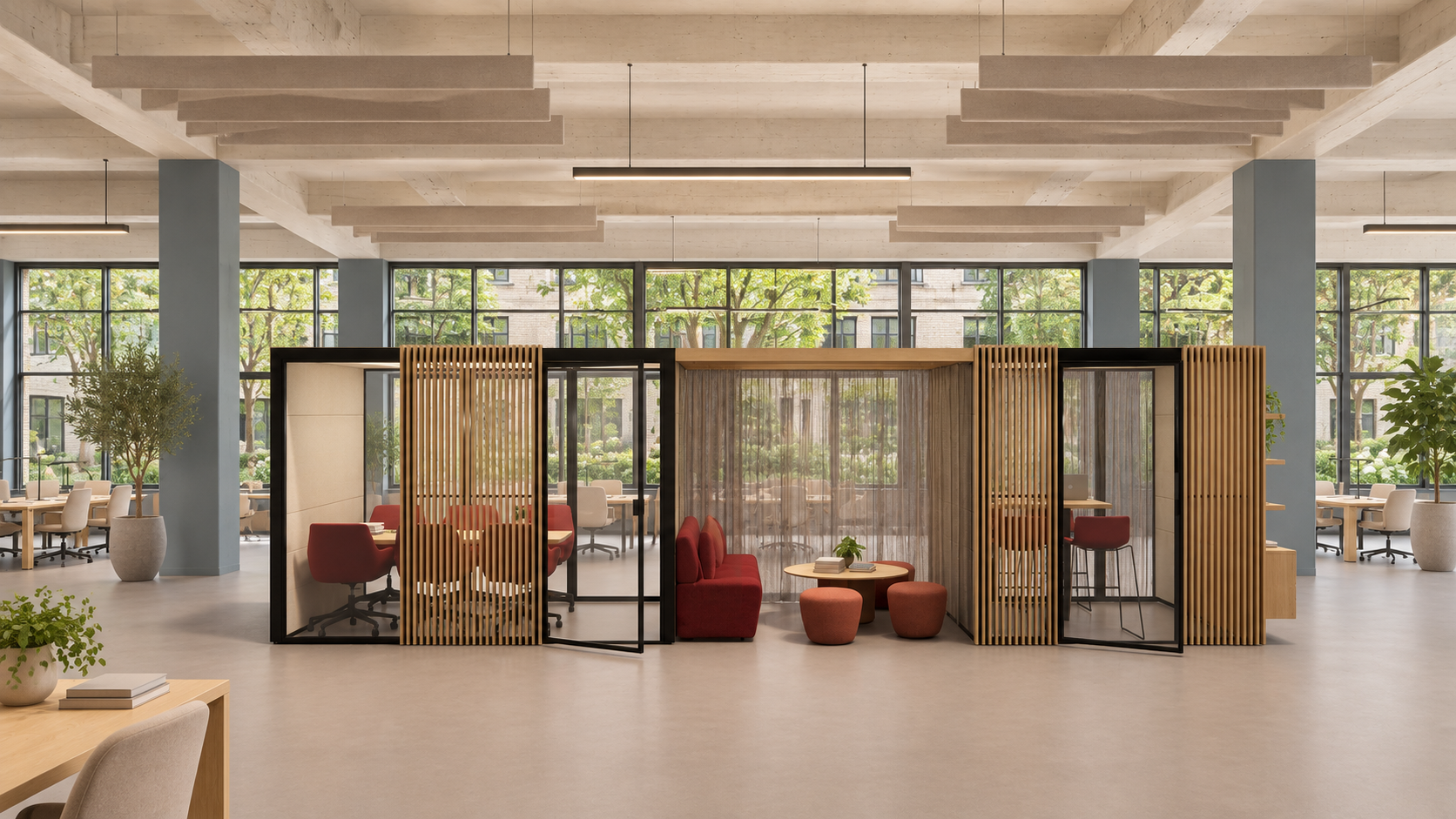
Why open office noise is a speech problem
Open office noise is rarely about volume alone. The real distraction is speech: a conversation you can follow is far harder to ignore than a hum you can't. That's why the useful question isn't “how quiet is it?” but “can people understand what is said on the other side of the room, or the other side of a wall?”
It also explains why one solution rarely does everything. Reducing echo helps a room feel calmer. Giving people a closed space to talk keeps speech where it belongs. Most offices need both. We wrote more about what that distraction costs in The Hidden Costs of a Noisy Workplace.
Option 1: acoustic panels, ceilings and soft furnishing
Sound-absorbing ceilings, wall panels, carpets, curtains and screens lower reverberation. Voices carry less far and the room feels less hectic.
Works well for: general calm across the floor, canteens and large open areas, and as a base layer under every other solution.
Limits: absorption doesn't create privacy. A colleague on a video call at the next desk is still a colleague on a video call at the next desk. Panels make the room better; they don't give anyone a place to talk.
Option 2: building meeting rooms or call rooms
Fixed rooms give the most enclosed space, and for large groups or confidential meetings they are often the right answer.
Works well for: larger meetings, boardrooms and spaces that will stay the same for many years.
Limits: building takes time and involves construction work on the floor. Walls also fix today's layout in place. When the team grows, moves floors or changes how it works, a built room stays where it is. If you're weighing this option, our comparison Office pod or traditional meeting room goes into installation and flexibility in more detail.
Option 3: office pods and phone booths
An office pod is a freestanding, enclosed space you place on the existing floor: an office phone booth for one person, a meeting pod for a small team, or a larger connected setup. It gives people a closed place to talk without building a room.
Works well for: calls and video meetings, focused work, and small meetings, close to where people sit.
What to check: “soundproof” is a marketing word; speech level reduction is a measurement. Ask for the ISO 23351-1 class. Ecolution Pods are certified ISO 23351-1 Category A, with 30.2 dB speech level reduction. That performance comes from the build-up: laminated 10.7 mm glass with an acoustic interlayer, 110 mm sound-absorbing panels, an automatic drop seal in the door, and a sound labyrinth in the plinths and ceiling. Read more in What does ISO 23351-1 Category A mean?
A closed space also needs fresh air and good light to be used for more than a few minutes. In our Pods, a motion sensor starts the lighting and the silent ventilation, which refreshes the air within two minutes. The 48V lighting is flicker-free, with adjustable light modes.
How to combine them
Start with the room. Absorption in ceilings and walls lowers the overall level and makes every other choice work better.
Count the calls, not the desks. Plan phone booths and meeting pods for your busiest office day. Our guide How many office phone booths does an office need? helps with the numbers.
Keep built rooms for what needs them. Large meetings and spaces that won't change are good candidates for construction.
Use the space around the Pods. With Landscapes, slats and privacy panels turn the area between and beside Pods into semi-private work spots. See Pod landscapes.
Plan for the next change. Teams grow and floor plans move. Pods that can be connected, extended or reconfigured follow that change. Our Pods connect without losing speech level reduction, and the door position can be changed on site. More in Connecting office pods.
Accessible and sustainable by design
A noise solution should work for everyone on the floor. Every Ecolution Pod is floorless and threshold-free. Wheelchair-accessible models such as the Eco Multi L and XL have a 917 mm wide door and a 1,500 mm turning circle inside.
If your organisation reports on its footprint, check the evidence too. Seven independently verified EPDs cover our entire collection, and across the collection our Pods contain at least 68% recycled material and are at least 98% recyclable. Every Pod comes with an Eco Passport. See our sustainability page for the details.
Frequently asked questions
What is the most effective open office noise solution?
There is rarely one solution. Acoustic panels and ceilings make the whole room calmer, while office pods and meeting rooms give people an enclosed place to talk. Most offices get the best result by combining them.
Are acoustic panels enough to stop distraction in an open office?
Panels reduce echo and make voices carry less far, but they don't create privacy for calls. For video meetings and confidential conversations, people need an enclosed space such as an office phone booth or meeting pod.
How do I compare office pods on acoustics?
Ask for the class according to ISO 23351-1, the standard for speech level reduction in enclosures. Ecolution Pods are certified Category A, with 30.2 dB speech level reduction.
Can office pods be moved when our floor plan changes?
Yes. Ecolution Pods are built from interchangeable components on one grid, so they can be extended, connected or reconfigured, and the door position can be changed on site.
Plan your quiet spaces
Every floor is different, and so is its busiest day. Look at your layout with our team, explore the collection or see why our Pods are built to change.
Start your project with a short video call.
